7 Common Mistakes When Opening an Online Store

Most mistakes when opening an online store aren't technical. Platforms today are simple enough that technically getting something wrong is actually difficult. The real mistakes come from insufficient preparation before launch — decisions that feel small in the moment but become expensive once the store is actually running with real customers and real money.
Here are the seven most common ones, with real context on why each one hurts, and how to avoid it.
1. Ignoring the platform's commission
This is the most expensive mistake on this list, because it doesn't feel like a mistake at first. Most beginners compare platforms only by the monthly subscription — 1,200 MKD versus 1,500 MKD feels like a small difference. But many platforms additionally take a 1-5% commission on every individual sale, on top of the subscription. At low sales volume, this looks negligible. At 150,000 MKD in monthly revenue, a 3% commission means 4,500 MKD every single month you've been giving away without noticing — 54,000 MKD a year.
Before choosing a platform, ask directly: is there a commission on sales, and how much does it come to at different volumes? Calculate exactly what commission would cost you at your expected sales volume before committing to any platform.
2. Starting with too broad a catalog
The instinct for many beginners is to publish as many products as possible from day one, thinking more selection means more chances to sell. In practice, this makes everything harder: it's difficult to produce quality photos for 100 products at once, difficult to track inventory across that many variants, and buyers aren't actually less confused — they often lose trust faster seeing a store with hundreds of poorly described products versus a store with twenty well-presented ones.
Start with a narrow catalog — the products you're most confident have real demand. Expand gradually, based on actual sales and customer questions, not assumptions.
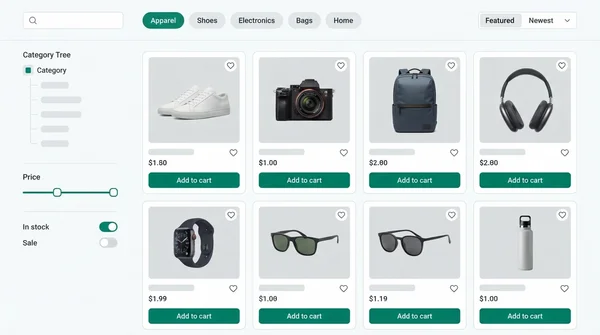
A store with 15 products, each with 4-5 professional photos and a clear description, sells better than a store with 150 products with one blurry photo each. Presentation quality carries more weight than range of offering, especially in the first few months while you're building trust with new buyers.
3. Overlooking domestic bank payments
Many beginners choose a platform based purely on design or price, without checking whether it actually supports direct integration with Macedonian banks. The result: they later discover payments route through a third-party intermediary, with extra fees and a more complicated process for every single order — or worse, that card payments don't work smoothly for domestic customers at all.
Check this before registering an account on any platform, not after you've already invested time setting up products and design. Direct integration with Halkbank/CaSys, NLB, or Komercijalna should be confirmed, not assumed.
4. Opening a store with no delivery plan
Delivery almost always gets solved reactively — after the first order arrives, under pressure, with no real agreed-upon rates or timeframes with a courier. This often results in inconsistent delivery times, unpredictable costs, and a poor experience for your very first customers — exactly the ones whose experience most influences future recommendations and reviews.
Before publishing your store, decide: which courier service you'll use, what the realistic delivery timeframes are to different parts of the country, whether delivery cost is built into pricing or charged separately, and whether you'll support cash on delivery — still a common preference among Macedonian buyers, especially on a first order from an unfamiliar store.
5. Underestimating technical maintenance
Self-hosted setups (via WordPress and WooCommerce plugins, for example) offer real flexibility, but come with ongoing technical responsibility that many beginners underestimate. Every plugin needs regular updates. A missed update can mean a security vulnerability, a compromised store, or a completely broken layout after an automatic WordPress update.
This doesn't mean self-hosting is the wrong choice — for some businesses, the flexibility justifies the technical responsibility. But the decision should be made deliberately, not by accident, because the cost of technical maintenance (whether in your own time or hiring a developer) is real and ongoing. More on the technical side of self-hosted setups.
6. Weak product photos
Online buyers have no way to physically touch, smell, or try a product — photos are the only proof of quality they have before buying. Dark, blurry, or inconsistent photos reduce trust, no matter how good the actual product is.
The investment here is small relative to the return: natural light or a ring light, a simple, clean background, and a few angles per product. This delivers a better return than an expensive store design or paid ads built around weak visuals.
7. Delaying launch while waiting for "perfect"
The most common mistake on this list, and possibly the most expensive. Waiting for a store to be completely perfect — perfect design, a full catalog, perfectly written descriptions — before publishing usually means months pass with zero real feedback from actual buyers.
The reality is that no plan survives contact with real customers unchanged. It's better to launch a simple but functional version early and improve gradually based on real experience, than to wait for perfection before the first sale.
What connects all of these mistakes
Notice that none of these seven mistakes are technically hard to avoid — all of them come down to preparation and a deliberate decision made before launch, not an expensive tool or advanced technical skill. A platform that already handles commission, domestic payments, and technical maintenance automatically removes mistakes 1, 3, and 5 from the list, with no extra effort on your part.
Avoid these mistakes from day one
Start your free 30-day trialOctober 29, 2026