How to Open an Online Store in Macedonia — A Complete Guide

Opening an online shop today takes far less technical knowledge and upfront capital than it did a few years ago. A handful of platforms can get a working store live in under 15 minutes. But the technical setup is actually the easy part — the decisions that determine whether your store succeeds happen before and after that 15-minute window: what you sell, how you're legally set up to sell it, how you get paid, and how you get your first customer.
This guide walks through all of it, step by step, with specifics for the Macedonian market rather than generic advice that assumes a US or EU setup.
1. Decide what you're going to sell
Before anything else — product and niche. The most reliable starting point is something you already understand: a hobby, a craft, or a product you're already selling informally through Instagram or Facebook DMs. If you're starting from zero, three approaches work reasonably well in the Macedonian market:
- A craft or skill you already have — handmade goods, baked goods, art, design work. Lowest startup cost, since you're not sourcing inventory from a supplier.
- Reselling imported goods — sourcing products (often from Turkish or Chinese wholesale markets) and selling at a markup. Requires more upfront capital for inventory, but a proven model in this region.
- Local manufacturing or production — food products, cosmetics, textiles made domestically. Often the hardest to start but the strongest long-term differentiation, since "locally made" is a real selling point many shoppers respond to.
Avoid overly broad categories at the start. "Handmade jewelry" is a much stronger starting position than "jewelry and accessories" — a specific offer is both easier to market and easier to be found for in search.

Whatever you choose, plan for how you'll photograph it from day one. Product photography is one of the few areas where a small investment (a ring light, a plain backdrop, natural window light) pays off far more than spending on store design — buyers can't touch the product, so photos are doing all the trust-building work.
2. Register your business
In Macedonia, selling online on a regular, ongoing basis requires a registered business entity — this isn't optional once you move past occasional, informal sales. Two common structures for a small online store:
- Sole proprietorship — the simpler, faster route for most solo sellers. Lower setup cost and simpler bookkeeping, though you're personally liable for business debts and we dont recommend it.
- LLC (limited liability company) — more paperwork and a higher setup cost, but separates personal and business liability. Usually worth it once revenue grows past a hobby level, or if you're bringing in a co-founder.
Registration through the Central Registry typically takes a few business days once paperwork is submitted. If you're still validating an idea, it's reasonable to test at a small scale first (a handful of sales through social media, for instance) and formalize registration once you see genuine demand — but be aware that card payments and direct bank transfers from most platforms require a registered entity before they'll connect your account.
3. Choose a platform for your online store
This decision shapes almost everything about your day-to-day operations going forward, so it's worth more than a few minutes of thought. The realistic options:
A global platform (Shopify being the best known) — mature, well-documented, huge ecosystem of themes and apps. The tradeoff for Macedonian sellers specifically: no direct support for Shopify Payments in Macedonia, meaning card payments route through third-party gateways with extra fees for each sale, monthly subscription for maintaining the online shop, and the interface and support aren't in Macedonian. More on what this actually means in practice.
Self-hosted via WooCommerce + WordPress — maximum flexibility, free core software, large community. The real cost isn't the software — it's hosting, security updates, and the near-certainty that you'll need a developer at some point for anything beyond a basic setup. Although it may initially seem like the most ideal and cost-effective option, that is not actually the case, and many young entrepreneurs make this mistake. The online store gets built, but they are often unaware that someone needs to handle software security and updates—which entails an additional cost, given that WooCommerce and WordPress are open-source platforms frequently targeted by hackers. A closer look at the self-hosted route.
A local platform built for the Macedonian market — direct integration with domestic banks (Halkbank/CaSys, NLB, Komercijalna) from day one, Macedonian-language interface and support, no need to assemble hosting, security, and payments separately.
There's no universally "correct" answer — it depends on how much you value flexibility versus how much you value not having to manage the technical side yourself.
4. Set up payments through domestic banks
This is a step where many first-time sellers lose real time. International payment processors don't always integrate smoothly with Macedonian bank accounts, and the fallback — routing through a third-party gateway — usually means extra transaction fees stacked on top of normal processing costs.
Before committing to an e-commerce platform, confirm directly whether it offers integration with Halkbank, NLB, or Komercijalna bank. Also decide early whether you'll support cash on delivery (COD) — still a common preference among Macedonian online shoppers, particularly for first-time buyers who haven't built trust with a new store yet. Supporting both card payment and COD from launch typically converts better than card-only.
5. Plan delivery and logistics before you need to
Delivery tends to get solved reactively — after the first order arrives, under pressure, with no real plan. Decide in advance:
- Which courier service(s) you'll use, and their actual delivery timeframes to different parts of the country
- Whether delivery cost is passed to the customer, built into pricing, or offered free above a certain order value
- How COD payments get reconciled with the courier (this varies by provider and is worth confirming directly)
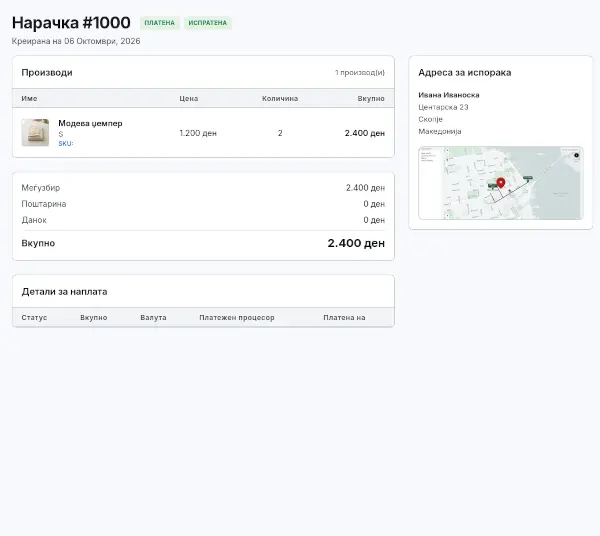
A clear process for packing, labeling, and handing off orders — even a simple checklist — prevents the chaos that hits most new sellers in their first week of real orders.
6. Add products
Photos and descriptions matter more than store design at this stage. A buyer deciding whether to trust a brand-new store is looking at: do the photos look professional, is the description clear and specific, are there any reviews or social proof yet. None of that depends on an expensive theme.
Start smaller than feels comfortable — 10-15 well-presented products beats 100 thin listings. You can always expand the catalog once you understand what's actually selling.
7. Getting your first sale
This is the part most setup guides skip, and it's usually the hardest part in practice. A few approaches that work for new Macedonian stores specifically:
- Convert your existing audience first — if you've been selling through Instagram or Facebook DMs, your existing followers are your warmest, cheapest first customers. Announce the store directly to them before spending anything on ads.
- Local Facebook groups and marketplaces — still heavily used in Macedonia for local buying/selling discovery, and a reasonable low-cost way to get initial traction.
- Micro-influencers over big names — a smaller local creator with a genuinely engaged audience often converts better, and costs far less, than a large account with passive followers.
- Patience on paid ads — it's tempting to put money into Meta/Facebook ads immediately, but with zero reviews and no proven product-market fit, that spend is usually inefficient. Get your first 10-20 organic sales first; they'll tell you a lot about what messaging actually works before you pay to scale it.
How long the whole process realistically takes
The technical setup — registration on the e-commerce platform, choosing theme, products, payments — can genuinely be done in about 15 minutes with a platform built for it. What takes real time is everything around it: deciding on a product (days to weeks, if you're starting from scratch), registering the business (a few business days through the Central Registry), and preparing good photos and descriptions.
The most common mistake isn't a wrong technical choice — it's delay. Waiting for a "perfect" store before publishing usually means months pass with zero real feedback from actual buyers. A simple store live today beats a polished one that stays unpublished for another month.
Ready to take the first step?
Start your free 7-day trialOctober 9, 2026